

March 22-24 2026
In Riga, Erica Synths
By the Studio Tallinn 1965, Erica Synths and ensemble EMA
Organizer: ECCM (Estonian Center of Contemporary Music) eccm.ee
Registration (obligatory): https://forms.gle/bj9iDffZ7MJ6Kv1g9
More info: [email protected]
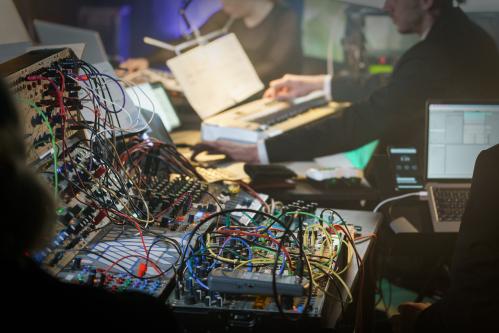
Live electronics has become an essential tool for music-making, not only for the younger generation of musicians but for artists worldwide. It has contributed to the democratization of music-making, allowing people without formal classical training in performance or composition to appear on stages across various genres. It has also significantly contributed to the emergence of the “hybrid” performer–composer, both in the underground experimental scene and in contemporary classical music. Yet in the contemporary music scene composing for performers with live electronics, especially for live electronic ensembles, is still not very widepread among classically educated composers. This is partly due to a certain conservative mindset in some conservatories, but mainly because of a lack of qualified teachers in the field and insuficienty of good knowledge-base and practical experience in working with live electronics composition and performance practice.
The workshop led by EMA in partnership with Erica Synths is designed for composers who want to dive into the composing for live electronics ensemble and to encourage composers with no previous experience in the field, as well as those who have it, to join.
Studio Tallinn 1965 is an open experimental, multifunctional analog music studio. Alongside modern phonics, analog devices from decades ago are also put to work to record sounds (professional old-time studio tape recorders) and to create music (classical oscillators, filters, echo machines). We approach music through the concrete artifacts and technological layers that range from hardware to software processes that have been part of the circulation of time and memory that condition the knowledge, but also the perceptions, and the sensations.
Acclaimed ensemble EMA (Estonian Electronic Music Society's Ensemble) was founded in 2017 and currently consists of 5 musicians with different classical education backgrounds (composition, different interpretation studies) and also with backgrounds in various experimental music scenes. Ensemble has been actively performing and composing live electronic compositions, and has led several workshops in which there were addressed several mutually related subjects, such as: notation for electronic music, technical setups, sound synthesis, etc. www.emamusic.ee
Topics of the workshop
-
Live electronics instruments. What are they? How to define them? How to classify them?
-
Sound design as one of the key elements in working with electronics.
-
Challenges in finding a common ground between composer and performer when working with "unknown", nonstandardized instrumentarium.
-
Different notation options for compositions that invole live electronics performance.
-
Technical obstacles when working with electronic setup. Mapping possibilities and challenges.
-
Syncing performers in real time. Options of different metronomes, Vclick app.
Schedule
March 22
Session 1. 16.00 - 19.00
Introduction.
-
Live electronics instruments. What are they? How to define them? How to classify them?
-
Particularities of different performance devices.
-
Challenges in finding a common ground between composer and performer when working with "unknown", nonstandardized instrumentarium.
March 23
Session 2. 10.00 - 13.00
Continuation topics from previous sessions.
-
Different notation options for compositions that invole live electronics performance.
Session 3. 15.00 - 18.00
-
Technical obstacles when working with electronic setup. Mapping possibilities and challenges.
-
Syncing performers in real time. Options of different metronomes, Vclick app.
March 24
Session 4. 10.00 - 13.00
Analyzing scores, conclusions, roundtable discussion and brainstorm.
ULYSSES JOURNEYS FOR LIVE ELECTRONICS COMPOSING VOL 2.
This workshop is conceived as a hands-on laboratory with EMA (Estonian Electronic Music Society Ensemble), in which participants will develop material they have brought with them. Six participants will be selected through an open call. Participants will present their preliminary ideas, sketches, and concepts, addressing questions related to the overall artistic concept of the work, sound design, and instrumentation.
The call is open from March 25 to April 8 2026.